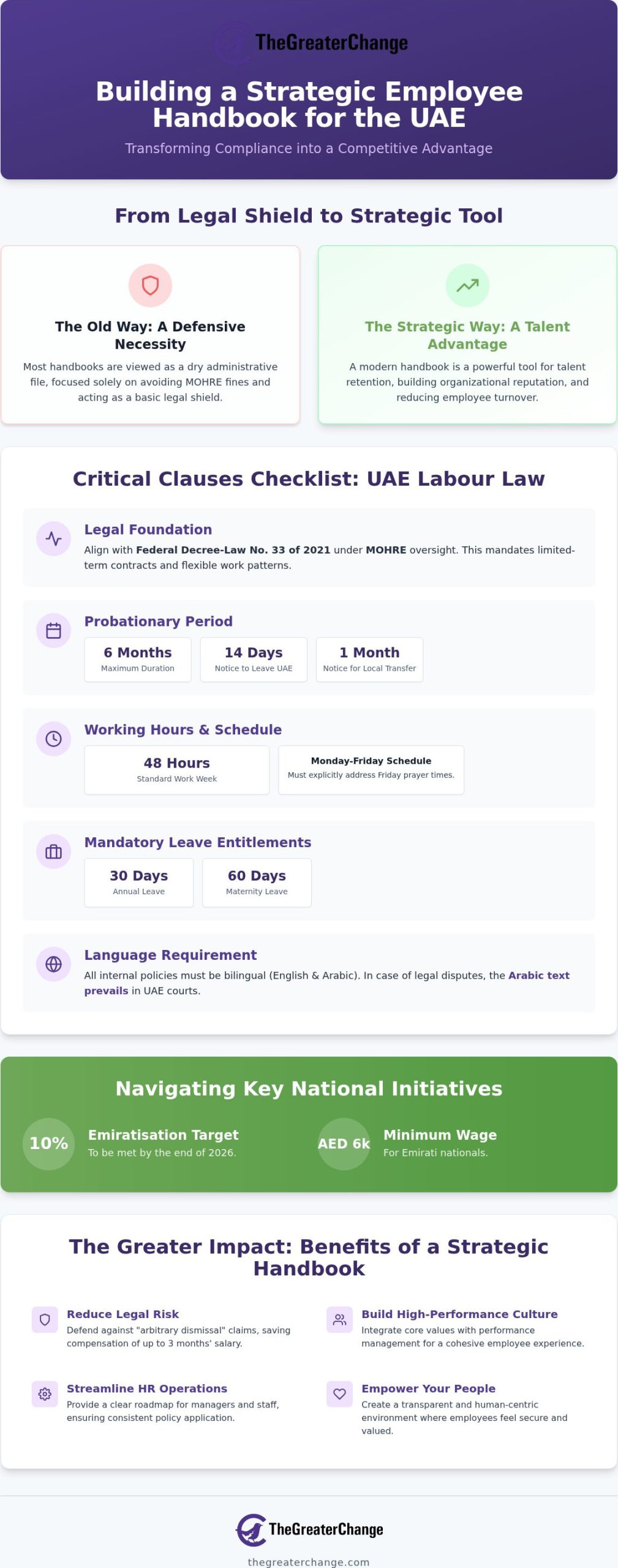
What if your employee handbook was more than just a legal shield against MOHRE fines? Most business leaders in the region view their internal policies as a defensive necessity, a way to stay on the right side of Federal Decree-Law No. 33 of 2021 and the critical 2026 updates. However, an employee handbook UAE labour law compliant document should actually be your most powerful tool for talent retention. You’re likely feeling the pressure of meeting the 10% Emiratisation target by the end of 2026 or managing the precise requirements for the new AED 6,000 minimum wage for Emirati nationals. These aren’t just administrative hurdles; they’re the building blocks of your organizational reputation.
We understand that aligning daily operations with shifting regulations can feel like a moving target. This guide will help you master the complexities of national labour regulations while building a high-performance culture through a compliant, strategic framework. We’ll explore how to transform dry legal mandates into a clear roadmap that reduces turnover, streamlines HR operations, and ensures your business remains both legally airtight and human-centric. By the end of this article, you’ll have the clarity needed to build a handbook that protects your interests and empowers your people.
Key Takeaways
- Establish a secure legal foundation by aligning your internal framework with Federal Decree-Law No. 33 of 2021 and MOHRE oversight.
- Learn to design an employee handbook in compliance with UAE labour law that clearly defines 2026 regulations for probation, working hours, and overtime.
- Transform your handbook from a dry administrative file into a strategic asset by integrating core values with your performance management system.
- Execute a structured HR audit to uncover hidden compliance risks and ensure your policies support a diverse, national workforce.
- Streamline your path toward organizational excellence by utilizing professional governance strategies that prioritize both legal safety and employee clarity.
The Legal Foundation: Why UAE Labour Law Requires a Robust Policy Framework
Establishing a firm legal foundation isn’t just about avoiding penalties; it’s about creating a predictable environment where both the employer and employee can thrive. In the UAE, the primary regulatory pillar is Federal Decree-Law No. 33 of 2021. This legislation revolutionized the private sector by mandating limited term contracts and introducing flexible work patterns. While many businesses believe a standard employment contract provides sufficient protection, relying solely on that document often leaves dangerous gaps in your HR governance. A standard contract is a skeleton; your handbook is the muscle that gives your organization its specific shape and strength.
The UAE Ministry of Human Resources and Emiratisation (MoHRE) serves as the ultimate guardian of these workplace standards. They provide the oversight that ensures every internal policy aligns with national goals, including the critical Emiratisation targets for 2026. An employee handbook UAE labour law compliant structure acts as a vital bridge between broad federal mandates and the specific daily realities of your office or site. It translates high level law into actionable rules that your team can actually follow.
Compliance as a Risk Management Strategy
How do you defend your business during a labour dispute? Without a detailed handbook, you lack the evidentiary trail needed to justify disciplinary actions. A well structured handbook serves as primary evidence in dispute resolutions, proving that the employee was aware of the rules and the consequences of breaking them. By standardizing your disciplinary procedures, you significantly reduce the risk of "arbitrary dismissal" claims. These claims aren’t just a legal headache; they can result in court ordered compensation of up to three months’ basic salary, creating an unnecessary financial drain on your operations.
Mandatory vs. Discretionary Policies
Success in UAE HR management requires a clear distinction between what the law demands and what your culture encourages. Certain clauses, such as those regarding the 30 day annual leave entitlement or the 60 day maternity leave period, must match the federal law exactly. You cannot "contract out" of these minimum standards. However, you have the flexibility to offer discretionary benefits that go beyond the legal minimum, such as extended paternity leave or enhanced health insurance tiers.
To maintain legal validity, you must ensure all internal documentation is bilingual. Article 18 of the Implementing Regulations requires that if an employer uses a language other than Arabic, the Arabic text remains the version that prevails in legal contexts. If your handbook isn’t professionally translated into both English and Arabic, its standing in a UAE court could be compromised. This dual language approach ensures transparency and protects your business from claims of miscommunication or lack of clarity.
Critical Clauses: Aligning Your Handbook with Latest UAE Regulations
Aligning your internal policies with current standards requires precision. An employee handbook UAE labour law compliant manual must reflect the specific adjustments introduced in recent years to ensure your operations remain above board. It isn’t just about listing rules; it’s about setting clear expectations that protect the business while respecting employee rights. When these clauses are drafted with care, they serve as the ultimate reference point for both managers and staff.
Probationary periods are a critical first step in this alignment. Under Federal Decree-Law No. 33 of 2021, these are capped at a maximum of six months. If an employee wishes to resign during probation to leave the UAE, they must provide at least 14 days’ written notice. If they’re joining another employer within the country, that notice period extends to one month. Your handbook should clearly state these timelines to prevent confusion during the onboarding phase.
Working hours and leave entitlements also require careful documentation. The standard work week is 48 hours, but with the nationwide shift to a Monday-Friday schedule, you must explicitly address Friday afternoon shifts. This ensures your team understands how the 1:15 PM prayer time is accommodated within the 8 hour workday. Leave policies have also matured; female employees now receive 60 days of maternity leave, consisting of 45 days at full pay and 15 days at half pay. Additionally, both parents can access five days of paid parental leave within the first six months of their child’s birth.
Managing the transition to End of Service Gratuity (ESG) is another essential component. For those with one to five years of service, gratuity is calculated at 21 days’ basic salary per year. For service beyond five years, it increases to 30 days per year. As the UAE moves toward voluntary savings schemes, your handbook should clarify whether your organization adheres to the traditional ESG model or has transitioned to a modern investment fund. If you’re unsure how to structure these complex financial obligations, our team can assist in developing HR Compliant Policies that mitigate long term risk.
Probation and Termination Nuances
Success during the probationary period depends on clear communication and rigorous documentation. You must record performance issues consistently to justify a termination within legal bounds, as this prevents future claims of unfair treatment. Non-compete clauses are also enforceable under the new law, provided they’re limited to a maximum of two years and are specific in terms of geographical scope and the nature of the work. Clearly defining these boundaries helps protect your intellectual property without infringing on an individual’s right to work.
Workplace Conduct and Anti-Discrimination
The UAE maintains a zero-tolerance stance on workplace harassment and bullying. According to 2026 UAE standards, workplace harassment is defined as any physical, verbal, or psychological behavior directed at an individual that violates their dignity or creates an intimidating, hostile, or offensive environment. Your handbook should also mandate equal pay for equal work, ensuring that compensation structures are gender-neutral and based entirely on competency. By formalizing these ethical standards, you build a culture of respect and professional integrity.
Beyond Compliance: Integrating Performance and Culture into Your Handbook
While the legal framework is a non-negotiable starting point, a truly sophisticated employee handbook UAE labour law document does more than just list prohibitions. It serves as the primary manual for organizational excellence. It translates abstract corporate values into concrete, actionable workplace behaviors. Instead of just saying "we value integrity," a high-standard handbook defines what integrity looks like in client interactions or internal reporting. This level of clarity builds a psychological contract where employees feel secure because they understand the literal path to success. Trust isn’t built on vague promises; it’s built on transparent, well-defined expectations.
Think of your handbook as your first real conversation with a new hire. It isn’t just a collection of rules; it’s a strategic tool for talent acquisition. When a new team member sees a document that balances legal rigor with a clear vision for professional development, their commitment to the organization solidifies. In the competitive UAE market, where skilled professionals have numerous options, projecting a professional and well-governed image is vital. A handbook that outlines clear pathways for advancement and support makes your company stand out as an employer of choice.
KPIs and Performance Transparency
Performance shouldn’t be a mystery. By defining your appraisal cycle and performance metrics within the policy framework, you eliminate ambiguity and reduce anxiety. Linking your handbook to a robust KPIs & Performance Management system ensures that every employee knows exactly how they’re measured and rewarded. This transparency is the foundation of high engagement. When you integrate Competency Mapping into your policies, you show employees a literal map of their professional growth. They don’t just see their current role; they see the skills required for their next promotion. This proactive approach turns a static document into a dynamic engine for long-term retention.
Building a Human-Centric Culture
Great leaders don’t just issue mandates; they explain the purpose behind them. A human-centric handbook communicates the "why" behind the regulations to foster genuine alignment across the workforce. For example, explaining that specific safety protocols exist to protect the physical well-being of the team, rather than just to meet a regulatory checkbox, demonstrates social consciousness. This is where your handbook transitions from a dry "rulebook" into a "Strategic Architecture." It emphasizes well-being and ethics, positioning your brand as a partner in the employee’s life. By focusing on the human experience, you create an environment where people don’t just work for you; they believe in what you’re building together.
Implementation Strategy: Rolling Out Policies to a National Workforce
Successfully launching an employee handbook UAE labour law framework requires a methodical approach that goes beyond simply emailing a PDF to your staff. It involves a strategic rollout that ensures every member of your national workforce, from C-suite executives to site-based teams, understands their rights and obligations. In a landscape where MoHRE enforcement is increasingly digital and data-driven, your implementation strategy must be equally modern. Moving from a static document to an interactive, digitally signed policy isn’t just a matter of convenience; it’s a vital step in maintaining a transparent and legally defensible HR infrastructure.
The HR Audit: Your Starting Point
The audit phase is where you identify the "Compliance Gaps" that often lead to heavy financial penalties. You must review existing contracts, offer letters, and informal practices to ensure they don’t contradict the 2021 Labour Law or the 2026 Emiratisation mandates. For a typical UAE SME with 50 to 150 employees, a comprehensive HR audit generally takes between two to four weeks to complete, depending on the complexity of current records. This initial investment in time prevents the much larger costs associated with labour disputes and regulatory fines later on. If you haven’t reviewed your internal governance recently, engaging professional HR audit services UAE businesses rely on provides the steady hand needed to secure your foundation.
Effective Communication and Acknowledgement
Communication is the heartbeat of successful policy implementation. You can’t expect compliance if your team doesn’t understand the rules. Standardizing an "Acknowledgement of Receipt" is a non-negotiable step for legal protection. It provides proof that the employee has received, read, and understood the policies. However, true alignment comes from training your managers to enforce these rules consistently. When policy application is erratic, it breeds resentment and increases turnover. You must also establish a clear process for managing updates. As the UAE government introduces new nuances, your digital handbook should be updated in real-time, with new acknowledgements tracked through your HR software.
Drafting and legal vetting must be the final gate before distribution. This ensures that every clause, from the new minimum wage requirements to the specific Arabic terminology used in disciplinary sections, is accurate. Using digital HR platforms for this distribution allows for easy version control. It ensures that an employee is never looking at an outdated 2021 version when they should be following 2026 protocols. By digitizing the signature process, you create an unalterable audit trail that protects your organization during any future MOHRE inspections.
Professional HR Governance: The Greater Change Advantage
Managing a growing workforce in the Emirates requires more than just administrative diligence; it demands a visionary approach to people and policy. Many organizations fall into the trap of using generic templates to save time. However, an employee handbook UAE labour law compliant document must be as unique as the organization it governs. Off-the-shelf solutions frequently fail to account for the specific nuances of your industry or the cultural balance of a multinational team. At The Greater Change, we view policy development not as a checkbox exercise, but as a catalyst for sustainable organizational growth.
Our project-based consulting model allows us to dive deep into your existing culture to build a framework that reflects your true values. We don’t just hand over a document and walk away. We integrate handbook creation with a wider HR audit services UAE organizations trust to ensure your entire infrastructure is resilient. This holistic method ensures that your internal rules don’t just satisfy a MOHRE inspector; they actively improve the daily experience of your employees. When policies are clear, fair, and human-centric, the resulting stability becomes a competitive advantage in the local market.
Tailored Solutions for National Growth
The complexity of the UAE regulatory environment makes precision essential. This is especially true with the 2026 Emiratisation targets and the AED 6,000 minimum wage requirements for UAE nationals. We blend legal rigour with human empathy to create policies that people actually want to follow. By clearly defining career paths and competency mapping within their handbooks, our clients have seen a marked improvement in employee engagement and a noticeable decrease in turnover rates. This isn’t a coincidence. It’s the direct result of replacing ambiguity with a structured, supportive environment where everyone knows where they stand.
Your Partner in Strategic HR
Transitioning from an administrative burden to a strategic HR partnership is the final step in your organizational evolution. We help you move beyond the daily firefighting of compliance issues so you can focus on long term talent development and scaling your operations. Our consultants are ready to conduct a comprehensive review of your HR infrastructure, ensuring your policies are ready for the challenges of 2026 and beyond. Don’t leave your compliance to chance or outdated templates. It’s time to build a foundation that protects your business and empowers your people.
Optimise your HR compliance with The Greater Change and ensure your organization is a benchmark for professional excellence in the UAE.
Future-Proofing Your HR Infrastructure for 2026 and Beyond
Transforming your organizational framework into a high-performance engine starts with a clear, strategic vision. We have explored how a robust employee handbook UAE labour law compliant structure serves as the essential bridge between federal mandates and your unique company culture. By standardizing disciplinary procedures and integrating clear KPIs, you don’t just mitigate the risk of MOHRE fines; you build a foundation of trust that significantly reduces employee turnover. This guide has detailed the path from conducting a rigorous HR audit to implementing digital signatures for seamless governance.
As specialists in UAE National Labour Law, our team ensures your policies remain fully compliant with Federal Decree-Law No. 33 of 2021 while reflecting the latest 2026 regulatory nuances. We provide the expert HR Audit & Governance needed to turn an administrative burden into a strategic advantage. You’re now equipped to move forward with a handbook that protects your interests and empowers your people toward shared success.
Secure your business with a compliant UAE Employee Handbook and take the first step toward a more resilient, human-centric workplace. Your journey toward professional excellence is a continuous process of refinement. With a steady hand guiding your strategy, you can navigate the complexities of the national landscape with total confidence.
Frequently Asked Questions
Is an employee handbook legally mandatory in the UAE?
Companies with 50 or more employees are legally required to implement "Internal Work Regulations" that must be approved by the Ministry of Human Resources and Emiratisation. While smaller firms aren’t strictly mandated to have a full handbook, they must still maintain formal policies regarding disciplinary actions and grievances to comply with Federal Decree-Law No. 33 of 2021. Establishing these rules early protects your business from claims of arbitrary dismissal and ensures a consistent standard of governance across your entire team.
Can a UAE employee handbook be written only in English?
You cannot legally rely on an English-only document if a dispute reaches the UAE courts or MoHRE. Article 18 of the Implementing Regulations requires that all internal policies, records, and instructions be issued in Arabic. Most professional organizations utilize a side-by-side bilingual format. While you can use English for daily communication, the Arabic version is the only one that prevails in a legal context, making professional translation a non-negotiable requirement for your HR infrastructure.
How does the 2021 Labour Law affect existing employee handbooks?
The 2021 legislation fundamentally changed the landscape by mandating limited-term contracts and introducing diverse work patterns like part-time and flexible work. If your handbook was written before 2022, it likely contains outdated references to "unlimited" contracts and lacks the newly required leave entitlements, such as parental leave. An outdated employee handbook UAE labour law framework is a significant liability, as it may contain clauses that are now legally null and void.
What are the penalties for non-compliant HR policies in the UAE?
Fines for violating labour regulations can range from AED 5,000 to AED 1,000,000 depending on the severity and frequency of the breach. In 2026, authorities are particularly vigilant regarding "fake Emiratisation" and circumvention of quota deadlines, with fines for these specific offenses starting at AED 100,000. Beyond direct financial penalties, non-compliance can lead to the suspension of your work permit facilities, effectively halting your ability to hire new talent or renew existing visas.
How often should a company update its employee handbook?
You should conduct a formal review of your policies at least once every twelve months to account for annual regulatory shifts. The UAE’s labour market is dynamic, with frequent updates to Emiratisation targets, minimum wage requirements, and public holiday announcements. Staying on an annual update cycle ensures that your employee handbook UAE labour law alignment remains perfect, preventing the administrative friction that occurs when internal rules fall out of sync with national mandates.
Can an employee handbook override the terms in a MOHRE contract?
An internal handbook cannot override the standard MoHRE contract if the handbook’s terms are less favourable to the employee. Any clause that attempts to reduce statutory benefits, such as offering fewer than 30 days of annual leave, is automatically considered invalid. However, a handbook can absolutely enhance the contract by offering superior benefits, such as extended maternity leave or private health insurance tiers, which then become contractually binding for the employer.
What is the "End of Service Gratuity" clause requirement in 2026?
Your handbook must accurately reflect the calculation based on the employee’s basic salary: 21 days for each year of the first five years and 30 days for each additional year. By 2026, many companies are also transitioning to the voluntary "Savings Scheme" as an alternative to traditional gratuity. Your policy must clearly specify which system applies to your workforce and how the transition from the old gratuity model is managed to ensure total financial transparency.
How should a handbook address remote or hybrid work under UAE law?
A modern handbook must define the specific "work from home" parameters, including core hours of availability and data protection obligations under Federal Decree-Law No. 45 of 2021. You must clarify that the employer’s health and safety obligations still apply to remote settings. Defining these expectations in writing helps maintain productivity and ensures that your team understands that remote work is a flexible work pattern governed by the same professional standards as office-based roles.