Have you ever tried to untie a tangled knot in a piece of silk? If you pull too quickly or with too much force, the fibers tighten and the damage becomes permanent. A professional exit in the workplace requires that same level of patient precision. It’s a moment where the cold letters of the law meet the warmth of a human career. Mastering the employee termination process UAE is the key to ensuring that knot is untied cleanly. You likely feel the weight of this responsibility, perhaps worrying about potential MoHRE disputes or the complex math of an end-of-service settlement. It’s natural to feel anxious about conducting a meeting that changes someone’s trajectory.
This guide will help you master every legal and operational requirement by providing a clear, risk-free roadmap. We’ll explore how to navigate Federal Decree-Law No. 33 of 2021 with confidence, calculate benefits accurately, and protect your company’s reputation through every step of the transition. By aligning your internal policies with current regulations, you can transform a difficult administrative task into a structured, respectful process that honors both the law and the individual.
Key Takeaways
- Navigate the complexities of Federal Decree-Law No. 33 of 2021 to ensure every contract transition is handled with legal precision and professional grace.
- Master the step-by-step employee termination process UAE to lead difficult conversations with confidence while protecting your business from arbitrary dismissal claims.
- Secure your final settlements by calculating end-of-service benefits and leave encashments accurately within the required 14-day payment window.
- Strengthen your organizational resilience through HR audits and clear policy handbooks that turn compliance into a cornerstone of your company culture.
Understanding the Legal Framework: UAE Labour Law 2026
A gardener knows that pruning a branch isn’t an act of aggression. It’s a necessary, often painful, step to ensure the rest of the tree thrives. In the workplace, letting someone go is the most difficult “pruning” a leader faces. It carries a heavy tension: the need to protect the organization’s future versus the weight of ending an individual’s current chapter. To navigate this without causing permanent damage, you need a steady hand and a clear map. In our region, that map is drawn by the Ministry of Human Resources and Emiratisation (MoHRE). As we move through 2026, the employee termination process UAE relies entirely on Federal Decree-Law No. 33 of 2021, which has fundamentally shifted how we view employment through the total abolition of unlimited contracts.
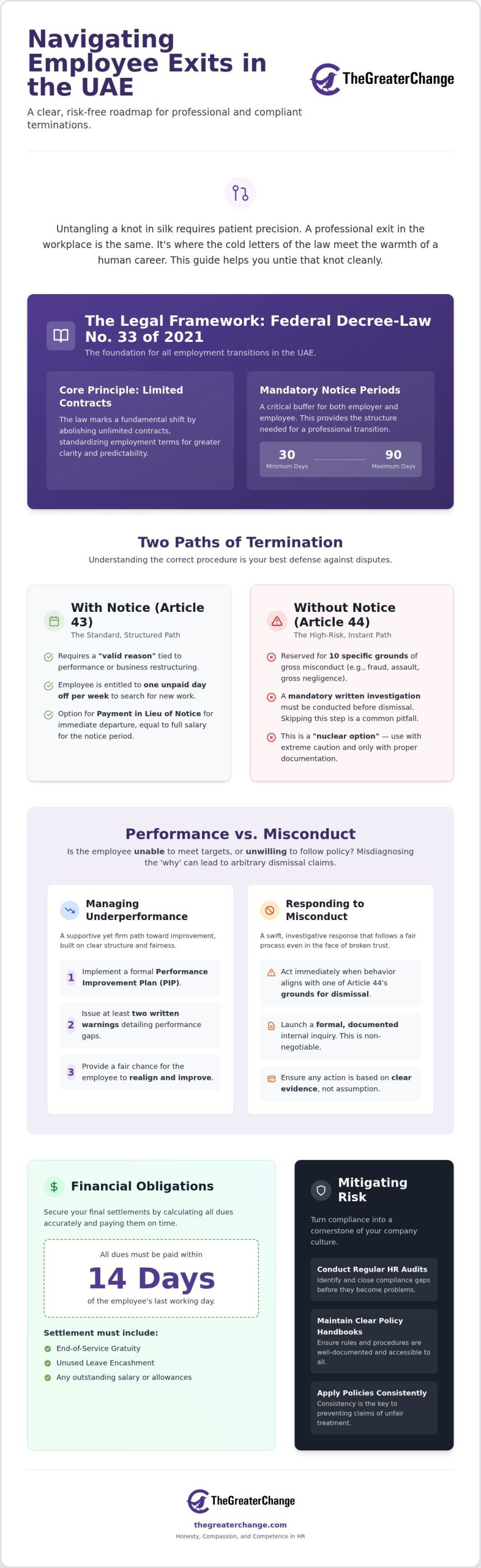
Notice periods serve as the essential buffer zone in this transition. By law, these must be at least 30 days but cannot exceed 90. They’re designed for transition, not tension. Whether you’re parting ways due to a shift in strategy or a misalignment in roles, these timelines provide the structure needed for a professional exit.
To reduce tension and support the well-being of your staff during these transition periods, you can check out Art Therapy for creative workshops that offer a constructive way to handle workplace stress.
Termination with Notice (Article 43)
Article 43 governs the standard path of separation. You must provide a “valid reason” for the exit, typically tied to performance or business restructuring. During this period, the employee is entitled to one unpaid day off per week to search for new work. If the situation requires an immediate departure, you can opt for “payment in lieu of notice.” This must equal the full salary the employee would’ve earned had they worked the remainder of their notice period.
Termination Without Notice (Article 44)
Sometimes, the bond of trust is broken instantly. Article 44 outlines 10 specific grounds for immediate dismissal, such as fraud, gross negligence, or being under the influence at work. Don’t rush this “nuclear option.” A common pitfall is skipping the mandatory written investigation. Without a documented internal inquiry, an immediate exit can backfire, highlighting why a structured employee termination process UAE is your best defense. Empathy doesn’t mean ignoring misconduct; it means following a process that remains fair even in the face of disappointment. Take a moment to reflect: do your current internal policies provide the evidence you’d need if a difficult conversation became necessary today? Beyond legal evidence, ensuring your digital environment is secure is vital; OAD Technologies provides the specialized cybersecurity support needed to protect your enterprise during such high-risk exits.
Grounds for Termination: Performance vs. Misconduct
Imagine a compass that has lost its magnetism versus a hiker who simply chooses to ignore the needle. One is a failure of function; the other is a failure of will. In the high-stakes environment of UAE business, leaders often struggle to distinguish between these two. Is an employee unable to meet their targets, or are they intentionally disregarding company policy? Correctly identifying the “why” behind a failing role is the first step in a compliant employee termination process UAE. If you misdiagnose a performance issue as misconduct, or vice versa, you risk an arbitrary dismissal claim. Performance issues require a supportive yet firm path toward improvement, while misconduct demands a swift, investigative response.
Managing Underperformance Legally
Technical skill gaps shouldn’t result in immediate exits. Instead, they require a documented journey. A formal Performance Improvement Plan (PIP) acts as your legal safety net. This process should include at least two written warnings, clearly stating the gap between current output and required KPIs. This isn’t just about compliance; it’s about giving the individual a fair chance to realign. If you’re unsure about your current documentation standards, a quick HR Audit can reveal where your defenses are thin. Empathy is most effective when it’s built on a foundation of clear, honest structure.
Redundancy and Restructuring
Sometimes the role itself becomes the issue, not the person. While the term “redundancy” isn’t specifically defined as a separate category in the 2021 law, business restructuring is a recognized valid reason for termination with notice. This requires a transparent communication strategy. You aren’t just cutting costs; you’re redesigning the organization for future growth. According to a Legal Analysis of UAE Labour Law Updates, consistency in how you apply these restructuring policies is what prevents costly legal disputes. Honesty about the business reality, paired with compassion for the affected individuals, preserves your reputation and ensures a smooth employee termination process UAE.
In a relay race, the baton pass is the moment of highest risk. It’s where speed meets precision. If the grip is loose or the timing is off, the race ends in the dirt. The employee termination process UAE is your organization’s final baton pass. It requires a delicate balance of mechanical compliance and human dignity. You aren’t just closing a file; you’re managing a transition that impacts your company culture and the individual’s future.
A smooth transition is also about the personal well-being of the individual; for those in the UAE looking for high-quality groceries and a taste of home during a career change, you can check out Shift 2 Fresh.
Maintaining a sense of personal comfort is vital during career changes; for those who drive vehicles from popular Chinese manufacturers in the UAE, TheChiDrive offers premium accessories to enhance their daily driving experience.
Navigating the financial demands of housing can also be a major stressor during a job change; Rentify helps alleviate this by offering Rent Now, Pay Later options that allow UAE residents to better manage their rental budgets.
The Termination Meeting Protocol
Conducting the meeting is an exercise in professional grace. Choose a private, neutral setting early in the week; for organizations needing discreet, professional environments for sensitive discussions, you can learn more about BizCity Group and their flexible workspace solutions. Your script should be direct: state the decision clearly within the first minute, offer a brief, honest reason, and then pivot to the logistics of the exit. A neutral witness, typically from HR, serves as an objective observer to document the interaction and ensure procedural integrity. This isn’t about a lack of trust; it’s about protecting the clarity of the moment for both parties.
Administrative Offboarding
A seamless offboarding process also involves securing your company’s physical and digital assets; for reliable support with your office infrastructure during such transitions, GenX Systems LLC provides comprehensive IT hardware and networking solutions in Dubai.
Complementing these infrastructure needs, Rocatech provides smart security and business automation solutions to ensure your premises remain monitored and secure during the offboarding process.
Once the conversation ends, the operational work begins. You must initiate the MoHRE work permit cancellation and the residency visa revocation through the proper government channels. Simultaneously, revoke internal system access to protect data security while retrieving company property like laptops or access cards. Under UAE law, you’re also required to provide an Experience Certificate that notes the duration and nature of the role. If these administrative layers feel overwhelming, our Employee Termination Assistance service can provide the steady hand you need to ensure no detail is missed. Competence in these final steps is what preserves your brand’s integrity in the national talent market.
Financial Obligations and Final Settlements
If you’ve ever settled a long-standing tab at a neighborhood café, you know the quiet relief of a clean slate. There’s peace in knowing exactly what was consumed and what is now paid. In the corporate world, the final settlement is that closing of the ledger. It’s the moment where years of partnership are distilled into a single figure. This isn’t just about math; it’s about honoring a commitment. Accuracy here is an act of respect. If the numbers are wrong, the trust you’ve built dissolves. Mastering the employee termination process UAE requires you to be as precise with your checkbook as you are with your legal notice.
To maintain precision in your company’s financial operations, especially when managing final settlements, using the right tools is essential. Platforms like PaySelect allow businesses to compare and select the most efficient POS systems and payment gateways available in the UAE.
End of Service Gratuity Calculation
Gratuity is the cornerstone of the UAE’s social contract with its workforce. For employees with one to five years of service, you calculate 21 days of basic salary for each year. Once they cross the five-year mark, that rate increases to 30 days for every subsequent year. Remember, this calculation is based on the last basic salary, not the total package. While newer savings schemes are emerging for non-nationals, the traditional gratuity remains the standard. If you find these nuances daunting, our Employee Termination Assistance ensures your ledgers remain beyond reproach. Honesty in these figures protects your reputation long after the employee has left.
The Final Settlement Statement
Transparency is your best defense against future disputes. You must provide a clear breakdown that includes leave encashment, repatriation costs, and any legal deductions for outstanding loans. Unlike some regional competitors who overlook recent updates, it’s vital to remember that all payments must be finalized within 14 days of the contract end date. You should also remind employees of their responsibility toward the national Unemployment Insurance scheme to ensure their transition is smooth. Once the funds are transferred, obtaining a “Final Discharge” signature is vital. It’s not just a receipt; it’s a mutual acknowledgement that the employee termination process UAE has been completed with competence and care. As individuals receive their final settlements and look toward their next steps, they may also wish to explore Real Estate Brokerage Commissions to better understand the financial landscape of the Dubai property market with TAG Property.
Mitigating Risk with Strategic HR Governance
Have you ever noticed how a lighthouse stands perfectly still while the ocean rages around it? It doesn’t react to the storm; it’s built to withstand it. In business, your HR governance is that lighthouse. Most leaders wait for a MoHRE notification to look at their policies. That’s reactive maintenance. True competence lies in building a structure that prevents the leak before it starts. The employee termination process UAE is often where the most pressure is applied to your organizational hull. Mastering the employee termination process UAE through strategic governance ensures that when the winds shift, your business remains unshaken.
Proactive Compliance and HR Audits
An HR Audit isn’t a “gotcha” exercise. It’s a diagnostic tool that identifies gaps in your termination clauses before they become liabilities. Many businesses still rely on outdated templates that haven’t been fully reconciled with the 2021 reforms. Are your managers trained on the nuances of MoHRE compliance? Do they know how to document a performance gap versus a behavioral breach? Developing a compliant employee handbook sets clear expectations from day one. When everyone knows the rules of the game, involuntary turnover often decreases because the boundaries are visible and fair.
Secure your business with a comprehensive HR Audit from The Greater Change
The Greater Change: Your Partner in HR Excellence
Professional Employee Termination Assistance provides an objective, steady hand during these sensitive human moments. We help you customize HR policies to align with national Decree-Laws while ensuring the dignity of the individual remains intact. It’s not about being cold; it’s about being correct. A well-governed exit protects your brand and respects the person’s journey. By fostering a culture of engagement and honesty, you ensure that when a separation is necessary, it’s handled with the highest level of competence. While navigating organizational shifts, maintaining morale through high-quality corporate events is essential; to see how premier entertainment can benefit your team, visit Thomas McElroy. Let us help you turn a complex administrative burden into a streamlined, compliant strategy.
Contact us for professional Employee Termination Assistance
Building a Legacy of Professional Integrity
A door that is slammed shut leaves a rattle that everyone else in the office can feel. Closing it with a steady, respectful hand isn’t just about avoiding a noise. It’s about maintaining the integrity of the whole structure. Mastering the employee termination process UAE is that steady hand. You now have a clear roadmap for this transition. We’ve explored how Federal Decree-Law No. 33 of 2021 provides the boundaries and how precise financial settlements provide the necessary closure. Beyond these legalities, a resilient organization also prioritizes team morale; when it’s time to celebrate your workforce’s achievements, The Hitmen Trio provides the premier live music experience to make every corporate event unforgettable.
Strategic governance isn’t a burden; it’s the foundation of a resilient brand. By aligning your internal policies with national standards, you protect your company’s future while honoring the individual’s past. If these transitions feel daunting, remember that structure is the best antidote to anxiety. Protect your organization with expert HR consulting and termination assistance. Through tailored HR policy development and strategic performance management systems, we help you navigate the complexities of compliance with confidence. You’ve built a culture of excellence; let’s ensure every exit reflects those same high standards.
Frequently Asked Questions
Can an employer terminate an employee without notice in the UAE?
Yes, immediate dismissal is permitted under Article 44 for specific violations like fraud, gross negligence, or appearing at work under the influence. You must conduct a formal written investigation before making this move. Without documented proof of the inquiry, the exit risks being labeled unfair. It’s a high-stakes decision that requires absolute procedural precision to protect your business interests.
What is considered arbitrary dismissal under the new UAE Labour Law?
Arbitrary dismissal occurs when an employer terminates an employee for a reason unrelated to their work performance or a legal breach. If a court finds the dismissal was unfair, they can award the employee up to three months’ gross salary as compensation. This reality highlights why a structured employee termination process UAE is essential for legal safety and maintaining organizational peace.
How is the notice period calculated if it’s not mentioned in the contract?
Under current regulations, the minimum notice period is 30 days, even if the contract is silent on the matter. The law caps the maximum notice at 90 days. Since all contracts are now fixed-term, these boundaries ensure both parties have a predictable window to manage the transition. Review your internal policies to ensure they align with these statutory defaults for every role.
Are employees entitled to gratuity if they are terminated for misconduct?
Yes, employees are entitled to their full end-of-service gratuity even if they are dismissed for misconduct under Article 44. The 2021 Labour Law removed the previous right of employers to forfeit these benefits. This shift emphasizes that gratuity is an earned right based on years of service, not a reward for good behavior that can be revoked at the end.
What should be included in a UAE experience certificate?
A compliant experience certificate must state the employee’s start date, their end date, the total duration of service, and the nature of the work performed. It shouldn’t include negative feedback or subjective performance reviews. It’s a factual record of their contribution. Providing this is a mandatory step in the employee termination process UAE and demonstrates your commitment to professional competence.
How long does an employer have to pay the final settlement in the UAE?
You must pay all end-of-service entitlements within 14 days of the contract’s termination date. This includes the final salary, gratuity, and any unused leave encashment. Missing this deadline can lead to MoHRE disputes and potential administrative fines. Prompt payment is a simple way to show integrity and close the professional chapter without unnecessary friction or legal risk.
Can an employee work for a competitor after termination in the UAE?
Employees can work for a competitor unless a valid non-compete clause is explicitly written into their contract. This clause must be limited in time, geographical area, and the type of work to protect legitimate business interests. The maximum duration for such a restriction is two years. It’s a tool for protection, not a way to prevent someone from earning a living.
What happens if an employee refuses to sign the termination letter?
If an employee refuses to sign, you should have a witness present to document the refusal and then send the letter via registered mail or official email. This creates a verifiable record that the notice was served. It’s a tense human moment, but following this protocol ensures that the refusal doesn’t stall your legal timeline or the broader organizational transition process.