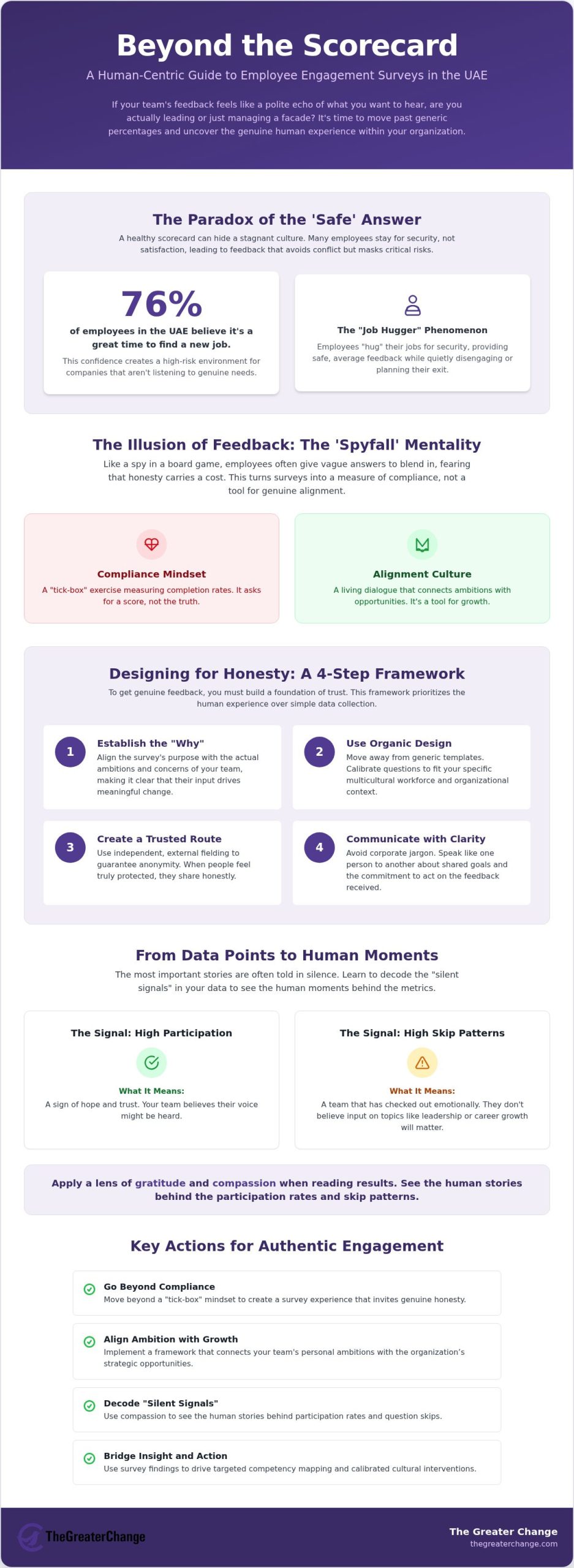
If your team’s feedback feels like a polite echo of what you want to hear, are you actually leading or just managing a facade? In the UAE, 76% of employees believe it’s a great time to find a job, yet many are “job hugging,” staying in roles for security rather than satisfaction. When you launch employee engagement surveys in the UAE, professionals often encounter the “safe” answer. It’s a frustrating paradox where the scorecard looks healthy, but the underlying culture feels stagnant. You know that metrics alone can’t capture the nuance of a multicultural workforce or the silent hesitation of a talented employee.
We agree that data is only valuable if it leads to meaningful change. This guide from The Greater Change promises to show you how to move past generic percentages to uncover the genuine human experience within your organization. We’ll examine how to align with Federal Decree Law No. 45 of 2021 while fostering a culture of honest communication. You’ll learn to translate feedback into strategic growth, turning “job huggers” into engaged contributors and ensuring your talent’s ambitions mirror your company’s opportunities.
Key Takeaways
- Move beyond the “tick-box” compliance mindset to create a survey experience that invites genuine honesty instead of safe, rehearsed answers.
- Implement a framework for employee engagement surveys UAE that aligns your team’s personal ambitions with your organization’s strategic growth opportunities.
- Learn to decode “silent signals” in your data, using a lens of compassion to see the human stories behind participation rates and skip patterns.
- Bridge the gap between insight and action by using your survey findings to drive targeted competency mapping and calibrated cultural interventions.
The Illusion of Feedback: Why Most Surveys Fail the Human Truth Test
Have you ever played the board game Spyfall? In it, one player is a spy who doesn’t know the location everyone else is at. To survive, they must give answers that are just vague enough to blend in. It’s a game of masks. Unfortunately, many professionals approach employee engagement surveys UAE with that same “spy” mentality. They don’t provide a perspective; they hide a secret. They look for the “safe” answer, the one that sounds like the corporate average, because they fear that honesty might carry a cost.
This is the illusion of feedback. We often mistake a high completion rate for high engagement, but a tick-box survey is merely a measure of compliance. A truly human-centric survey is a tool for alignment. It recognizes that employee engagement isn’t a static number to be reported to a board. It’s a living dialogue. Within the UAE business environment, we must prioritize honesty over artificial positivity. If your survey design doesn’t account for the human behind the screen, you aren’t measuring culture; you’re measuring a performance.
The Cost of the ‘Safe’ Answer
When employees give polite, “safe” averages, they mask significant commercial exposure. A team that scores a “4 out of 5” on every metric might actually be a team on the verge of mass turnover. Silence is expensive. In multicultural environments, generic templates fail because they don’t account for how different cultures express dissatisfaction. Some might use silence as a protest, while others use “safe” praise to avoid conflict. Without a diagnostic approach, you lose the ability to see these nuances. We must look at the people behind the numbers to see where ambitions and opportunities have drifted apart. I invite you to consider: are you asking for the truth, or just for a score?
Designing for Honesty: A Framework for UAE Workforces
Think of a compass placed next to a heavy magnet. The needle spins, looking for North but finding only the pull of the nearby metal. That’s what happens when you launch a survey without first building a foundation of trust. If employees feel the “magnet” of potential repercussions, their answers will always veer toward safety. To get genuine results from employee engagement surveys UAE leaders must follow a deliberate framework that prioritizes the human experience over simple data collection.
First, establish the “Why.” We must align the survey with the actual ambitions of the team. Second, move away from generic templates toward organic design. This means calibrating questions to fit your specific culture. Third, create a route employees trust by using independent, external fielding. Finally, communicate the purpose with clarity and competence. Don’t use corporate jargon; speak like one person to another about shared growth.
Calibrating for Multicultural Nuance
In a landscape as diverse as ours, linguistic clarity is essential. We must ensure that questions translate not just in words, but in meaning across different cultural backgrounds. Anonymity isn’t just a feature; it’s a core requirement for honesty. When people feel truly protected, they stop “job hugging” their opinions and start contributing to the solution.
Integrating Manager 360 Feedback
Engagement data is most powerful when paired with manager feedback tools. This integration allows you to tackle the employee engagement crisis by developing managers who are confident and empathetic. It’s not about finding faults. It’s about calibrating leadership to match the team’s needs. If you’re ready to move past generic metrics, our team can help you design a survey that actually speaks the truth.
From Data Points to Human Moments: Interpreting Results with Compassion
Imagine walking into a room where everyone is smiling, but no one is talking. The silence tells a story that the smiles try to hide. In the context of employee engagement surveys UAE, the “silent signals” are often found in what employees choose to ignore. High participation rates are a sign of hope, but high skip patterns in specific sections, like leadership or career progression, often signal a team that has checked out emotionally. They aren’t just skipping questions; they’re skipping over the belief that their input matters.
We must apply a lens of gratitude and compassion when reading these results. It’s easy to rush toward fixing deficiencies, but we first need to recognize the strengths that keep the organization running. This balanced view allows for a “Visionary Consultant” approach when speaking to the C-suite. We don’t just deliver a report of failures; we provide a diagnostic for growth. This data should directly inform your learning and development strategy UAE, ensuring that training isn’t just a generic exercise but a calibrated response to real human needs.
Naming Difficult Realities Clearly
Presenting negative feedback to leadership requires honesty without aggression. We call this “Calibrated Intervention.” It involves preserving the core cultural elements that work while naming the difficult realities that hinder progress. If a department feels unheard, we don’t just state the problem; we offer a structural path forward. This approach prevents defensive reactions and builds a bridge between current sentiment and future stability. If you need help translating your raw data into a strategic roadmap, contact our team for a partner-led diagnostic.
Calibrating Culture: Turning Survey Insights into Strategic HR Alignment
A blueprint sitting on a dusty desk is just paper. It only becomes a structure when you lay the first stone. Too many employee engagement surveys UAE results suffer a similar fate. They become “shelf-ware” that looks impressive in a boardroom but never influences the office floor. We must bridge the gap between insight and action by integrating findings into the very bones of the organization. This means using survey gaps to drive targeted competency mapping. If the data shows a lack of clarity in roles, we don’t just send an email; we recalibrate the competency framework to ensure every ambition has a clear path to an opportunity.
Authenticity is the currency of a sustainable employer brand. If your external recruitment message promises innovation but your internal employee engagement surveys UAE reveal a fear of failure, you have a mask, not a mirror. A true mirror allows you to see the reality of your culture and align your talent search with the people who will actually thrive there. It’s about honesty over optics.
Sustainable Change Management
Interventions don’t need to be loud to be effective. We believe in moving away from “big-bang” reactions that disrupt workflow without solving the root cause. Instead, we favor measured, data-driven shifts. The Greater Change helps organizations move forward in a structured, calm, and sustainable way. We ensure that every change is calibrated to the human moments that define your workplace. This steady hand allows for progress without the frantic pressure often associated with corporate overhauls.
I invite you to reflect: is your current survey a mirror that reveals the truth, or a mask that hides it? True growth begins when you’re brave enough to look at the reflection and act on what you see.
Calibrating Your Path to Sustainable Growth
A garden doesn’t grow just because you measured the soil; it grows because you adjusted the nutrients based on what the plants actually needed. We’ve explored how employee engagement surveys UAE organizations implement can shift from being mere compliance masks to becoming mirrors of true cultural health. It’s about moving beyond generic metrics to capture the genuine human moments that drive performance. By decoding silent signals and aligning talent with strategic opportunities, you transform raw data into a roadmap for retention and growth.
With over 25 years of GCC HR leadership, our MCIPD-chartered consultants specialize in business growth aligned with the UAE’s national vision objectives. We provide the steady hand needed to navigate complex cultural dynamics with competence and honesty. Ready to move past the scorecard? Schedule a free discovery call with The Greater Change to discuss your culture alignment. Your organization’s potential is hidden in the honest conversations you haven’t had yet. Let’s start them today.
Frequently Asked Questions
Is an external employee engagement survey better than an internal one in the UAE?
External surveys provide a neutral buffer that significantly increases the quality of feedback. In our diverse market, employees often hesitate to share truths if they believe internal HR can trace their responses. An external partner ensures compliance with Federal Decree Law No. 45 of 2021 while protecting participant identities. This professional distance changes the perception of the survey from a corporate monitoring tool into a genuine platform for human connection.
How often should national companies conduct engagement surveys?
We recommend an annual deep dive supported by shorter, quarterly pulse checks to maintain a steady rhythm of feedback. Conducting employee engagement surveys UAE too often can lead to survey fatigue, resulting in “safe” or hurried responses. The key is to allow enough time for leadership to act on previous insights. It’s far more effective to listen deeply and act decisively than to ask questions continuously without visible change.
Can engagement surveys help with employee retention in the UAE?
Surveys are essential for retention because they identify the specific tensions that cause talent to look elsewhere. With 76% of UAE employees feeling optimistic about finding new roles, companies must understand what keeps their team grounded. By identifying gaps in competency mapping or culture, you can calibrate your interventions to meet employee ambitions. This proactive approach prevents turnover by ensuring that talent feels seen, heard, and strategically valued by the organization.
What is the average response rate for employee engagement surveys in the UAE?
A healthy response rate usually ranges from 70% to 85% in the regional market. While higher numbers are possible, a perfect 100% rate sometimes signals that participation was forced rather than voluntary. We value the “silent signals” in these numbers. If participation is low, it’s often a diagnostic indicator of poor trust or a belief that previous feedback was ignored. Authentic engagement requires a voluntary commitment to the conversation.
How do you ensure anonymity in a small company survey?
Protecting anonymity in small organizations requires strict data aggregation and third-party management. We typically set a minimum threshold, such as five respondents, before sharing specific group data with leadership. This prevents the “process of elimination” that can happen in tight-knit teams. Using an external consultant ensures that raw data stays confidential, allowing employees to speak with honesty. It’s about building a structure where the truth can safely emerge without repercussions.